Friday, March 27, 2009

The Illustrated Rules of Football by R.L. "Buddy" Patey, illustrated by Patrick T. McRae- Nonfiction


This book was a nonfiction book. It discussed the rules, players, equipment, etc., involved in football. There were fifteen basic rules discussed. These topics of these rules included the field of play, the ball, the goalposts, yardage chain and down marker, required player equipment, the officials, game time, scoring, the captain, the teams, starting the game, putting the ball into play, formations, out-of-bounds, and fouls. The players were also discussed in detail, and these included the linemen, the backfield players, the pass receivers, the linebackers, and the kicker. The book also showed and described some important signals used in football. This book was written in very simple language and terms, and lots of pictures were used to help describe the rules. The important words were written in bold letters, and there was a glossary at the end of the book defining these words. One good thing about this book was that they usually discussed the differences in youth, high school, college, and professional football so that people would not assume the rules were the same for all levels of football. The book also mentioned several times the importance of having good sportsmanship when playing football, which is a great thing to have reinforced for kids.
This book is great for third-fifth graders. Many kids enjoy playing or watching football, so they would probably find this book entertaining. There are other people, like myself, who like to watch football but do not know all of the rules. This book really breaks down and simplifies the rules of the game. The pictures and diagrams help to explain everything, and these elements along with simple language make this book appropriate for English Language Learners or struggling readers. Of course, strong readers would like it too if they like football! Some students know nothing about football, and they might want to read this book to understand why their peers enjoy this sport. This is a great book to have available for students, because many of them will enjoy it! I actually dreaded reading non-fiction books for this project because I thought they were all boring, but when I chose non-fiction books that were on topics that interested me, I actually loved them! Hopefully books like this can help students to appreciate nonfiction books as well!

Grow Your Own Gargoyle by Valerie Hardin, illustrated by Carol Moore- Modern Fantasy/Science Fiction


This story is a very short modern fantasy/ science fiction story. A girl named Wendy liked to order toys out of her “Slime Sisters” comic book, such as talking fish, living pet rocks, and giant super heroes. Usually, the toys she orders end up breaking, being extremely small, and overall, they are disappointing. Wendy is starting to think that she should not order any more things from the comic book, but then her mom brings her a package. Wendy had ordered a “grow your own gargoyle” kit. The kit had two toy gargoyles, and the instructions said to put them in separate bowls of water over night. The next morning, the gargoyles had come to life! Wendy was scared but did not scream because she knew that gargoyles were cranky. Wendy ended up being friends with her gargoyles and keeping them. The gargoyles liked the same things as Wendy, such as pillow fights and drawing. They even get Wendy in trouble by messing up her room while she is at school! The gargoyles ask Wendy to get more gargoyles, but Wendy decides that two are enough for her.
This book is great for kids that love fantasy stories about creatures that come to life. Many children have wild imaginations and love this kind of story! The book is a quick and easy read, so it is great for struggling readers. However, I know plenty of advanced readers that still enjoy books like these! I know lots of boys who love books about creatures such as gargoyles, goblins, and vampires. Also, kids can relate to the beginning of this story because they have probably ordered a toy that ended up not being as good as they expected. I remember ordering toys when I was little, such as toys mentioned on the back of cereal boxes, and they usually ended up being a disappointment. I actually found this book on a website called MagicKeys.com, and it has free storybooks online! The books are divided into levels, which include books for young children, older children, and young adults. This story was in the “older children” category. There are books of many genres on this website, including other science fiction stories, such as one about aliens. This is a great website for any school because it expands the classroom library greatly! Just a few simple clicks on the computer can bring up tons of stories! There are even pictures online, so they are just like real paper copies! Websites such as these are especially helpful for schools that do not have a lot of money. If a school cannot afford to buy a lot of books, they can find tons of free books online (as long as they have Internet access.) A class can go from having thirty books to two hundred books! If teacher look for more websites like this, the numbers can be even larger.

Dinosaurs Before Dark- Magic Tree House- By Mary Pope Osborne, illustrated by Sal Murdocca- Modern Fantasy and Science Fiction and a Chapter Book


This book is an example of modern fantasy and science fiction, and it is also a chapter book. The book includes time travel, magic, and encounters with dinosaurs. A boy named Jack and his littler sister Annie find a very high tree house in the woods. Up in the tree house, there are tons of books. Jack loves dinosaurs, so Annie hands him a book about dinosaurs. He sees a picture of a dinosaur called a Pteranodon and says that he wishes he could see a real one. Suddenly, it got windy and the tree house spun around. Jack and Annie have just traveled back to the time of dinosaurs! They see a Pteranodon, a Triceratops, lots of Anatosauruses, and a Tyrannosaurus rex. Some of the dinosaurs are nice, and the Pteranodon even saves Jack from the T-rex in the end. Jack uses the dinosaur book to learn about the dinosaurs, and they learn things such as not to be afraid of the Triceratops because it only eats plants! Jack has to escape a T-rex in the end. The T-rex is about to get them, even though they are in the tall tree house. Jack finds a book about their hometown, Frog Creek, Pennsylvania, and he wishes to be back home. Sure enough, the tree house spins and takes them home! Jack and Annie decide to not tell anyone about their adventure because no one will believe them. Them know their adventure was not a dream because Jack found a gold medallion during their trip and it was still in his pocket when he got home. Jack and Annie decided to come back to the magic tree house the next day.
This book would be great for any students who like action and adventure. What is more adventurous than running from dinosaurs? It would also be great for students interested in dinosaurs. There are facts about dinosaurs throughout the book that help the children deal with the dinosaurs. If a student is interested in time travel, they would find this book interesting too. The book is a pretty quick and easy read considering it is a chapter book, so it could be a great way for struggling readers to begin reading chapter books. There are also lots of pictures in the book that add to the book, showing what various dinosaurs look like and guiding the story. Reading this book would probably inspire students to use their creativity and write action stories. The characters in this book loved to read, so this could inspire students to want to read. They see that they can have adventures by reading books. Even though they obviously will not actually travel through time, they can feel as though they were traveling anywhere in time or in the world just by reading!

Graphic Classics: Journey to the Center of the Earth by Jules Verne, Illustrated by Penko Gelev- Modern Fantasy or Science Fiction and a Graphic Novel


This book, originally by Jules Verne and retold by Fiona Macdonald, was an example of science fiction, and it was also a graphic novel. A Professor named Professor Otto Lidenbrock finds a hand-written book from Iceland. Inside this book, a piece of parchment falls out that is written in a strange code. The Professor’s nephew, Axel, eventually cracks the code and reads that to reach the center of the Earth, one must descend into the crater of Sneffels. The Professor wants to go explore the center of the Earth, and he makes Axel go with him. Axel is scared and sad to go because he has to leave the girl he loves, Grauben. However, he goes with the Professor. They first travel to Denmark and then to Iceland. A guide named Hans the Hunter goes with them on their journey to help them out. They end up going into the volcano and having many adventures. They almost die of thirst, find rushing water, get separated from one another, travel in darkness, find a strange island with giant mushrooms and dinosaur bones, see strange prehistoric animals that they believed to be extinct, see a geyser, get shipwrecked in a storm, see a prehistoric man, survive a volcanic explosion, and have many more adventures. They eventually end up in Sicily, which is not where they originally planned on going. Their compass had gotten messed up by lightning during their adventures. Finally, Axel and Grauben are reunited and get married. The Professor tells everyone about their crazy adventures, and everyone is happy. This book is written in the style of a graphic novel, so there are lots of comic-book style pictures, captions, and speech bubbles. This made the book flow quickly, and the crazy adventures could truly be “pictured” by looking at the wonderful pictures!
This book would be great to have in a third to fifth grade class. Many children, often boys, love adventure books, and this book is certainly full of adventure and action. This book could also be great for struggling readers since it is written as a graphic novel. There are not long sentences and paragraphs, and a struggling reader or English Language Learner could easily read this book by looking at the pictures. Besides being exciting, this book also has lots of information. Some of the events in the book are impossible, but this is cleared up at the end. There is a “fact and fiction” section that explains which parts of the book could and could not really happen. This book would be great for any students who love science fiction, action, or graphic novels! Perhaps students could create their own graphic novels after reading this. The excitement of the book could also spark creativity, and students could write a science fiction story of their own!

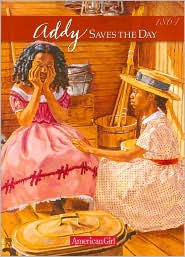
Addy Saves the Day by Connie Porter, illustrations by Dahl Taylor, Vignettes by Graef and Bourget- Realistic or Historical Fiction and a Chapter Book


“Addy Saves the Day” is part of the American Girl series. This book is a great example of realistic or historical fiction, and it is also a chapter book. Addy is a little girl who lives with her Momma and Poppa in Philadelphia. They used to be slaves, but slavery had recently ended and they were free. However, they had gotten separated from Addy’s little sister, Esther, and older brother, Sam. Esther was still on the plantation with Addy’s aunt and uncle, but they did not know where Sam was. The book was about how Addy and her parents worked hard to raise money so that Poppa could go search for Sam and Esther. They bought a small plot of land to plant vegetables. They also helped with a fair at their church that was raising money for many families, including theirs. Addy built spool puppets, Momma baked pies, and Poppa built slide whistles and a puppet stage. In addition to being sad about her siblings, Addy also gets in arguments with a girl named Harriet. By the end of the book, Addy and Harriet make up and become friends. At the fair, an older girl tries to steal their hard-earned money, and Addy and Harriet work together to stop her and save the day. At the very end, Addy’s brother, Sam, shows up at the fair! He is missing an arm, but he is safe and free! I was glad that this book had a happy ending.
This book is a great way to teach children about the impacts of slavery and the Civil War. Slavery, plantations, and the harsh conditions that Addy and her family went through are mentioned in the book. Addy’s family, like many other families, got separated because of slavery. In the book, only white soldiers marched in a parade, even though African American soldiers fought as well. Students can learn about the Civil War and slavery from the perspective of a girl who is about the same age of them, which make it easy to connect with. Children can connect with the fights that Addy had with Harriet, because many children have hard times getting along with classmates. If the students have family members fighting in Iraq, they can connect with the uncertainty of not knowing how a loved one is doing. The end of the book had lots of pictures and facts about life in 1864, focusing on outdoor life. This part told about segregation and the unsanitary conditions during that time. I definitely loved reading American Girl books when I was in fifth grade, so I know that many children will still love reading these books. They are interesting as well as informational! I would definitely recommend this book, along with all of the other American Girl books, to anyone!

Morning Girl by Michael Dorris- Realistic or Historical Fiction and a Chapter Book


“Morning Girl” is an example of realistic or historical fiction, and it is also a chapter book. The chapters alternate back and forth between the perspectives of a girl named Morning Girl and her little brother, Star Boy. Morning Girl loves to wake up early and she enjoys being alone in the morning. She goes out and swims, looks for shells, walks around the island, etc. Star Boy, on the other hand, likes to stay up at night and he loves looking at the sky. He usually sleeps a lot during the day. Morning Girl and Star Boy are like the typical brother and sister- they fight and annoy each other, but they stick up for each other when they need to. Star Boy once embarrassed himself in front of lots of people by running ahead and grabbing food during a large gathering. Morning Girl stuck up for him by running and grabbing food as well, telling everyone that they were all very hungry after searching for Star Boy during a big storm. Star Boy is very grateful for his sister after this, and he calls her “The One Who Stands Beside.” Throughout the book, Star Boy and Morning Girl describe all of their adventures, such as the terrible storm that Star Boy almost died in, when Star Boy hid in the rocks because he forgot to tie up his father’s canoe, and when Morning Girl’s family is sad because the new baby sister was never born. At the end of the book, Morning Girl is swimming and sees a canoe full of strange people. Morning Girl is very polite and speaks to these people, even though she thinks they dress and act very strangely. The epilogue then shows a journal entry from 1492 written by Christopher Columbus, and it turns out that the strange people Morning Girl met were Christopher Columbus and other explorers. I could tell that the book was set in a time long ago, but I did not realize the exact setting until the epilogue.
This book would be a great way for students to learn what life was like in America before it was “discovered” by Christopher Columbus. They can learn what life was like for Native American children and families, and they can see that the Native Americans actually did just fine before Columbus and others came. Students always learn the story of the discovery of America from the explorers’ points of view, but this tells the story from the perspective of the Native Americans. Students can also really connect to this book. Many of them have brothers and sisters that annoy them, but they also stick up for them in times of need. Children know what it is like to be embarrassed just like Star Boy was several times in the book. Star Boy and Morning Girl were supposed to get a new baby sister, but the baby died before it was born. Many families experience miscarriages, so students can relate to this as well. Some parts of the book are strangely worded, so parts might be confusing for students, but overall, this was a great book. Students can really enjoy this book, connect with the characters, and learn about life in America in the 1400’s!

Changes for Molly by Valerie Tripp, Illustrations by Nick Backes, Vignettes by Keith Skeen- Realistic or Historical Fiction and Chapter Book


This book is a great example of realistic or historical fiction, and it is also a chapter book. The book is about a ten-year-old girl named Molly McIntire and her friends and family. The book takes place in 1944 during World War Two. Molly, her mother, her siblings, and her friends, are all at home while Molly’s father is in England taking care of wounded soldiers, since he is a doctor. Molly’s father is about to come home, and Molly wants him to think she is grown up, so she works really hard to get the role of Miss Victory in a tap dance that would be the finale in a big show called, “Hurray for the U.S.A.” The show was going to be put on at a veteran’s hospital for all of the hurt soldiers and the whole town. Molly lands the role of Miss Victory, but on the day of the big show, she gets sick and cannot perform. She got sick because she had been sleeping and going to school with wet hair every day so that her hair would be curly for the show. Molly was very sad because her whole family went to see and perform in the show while she was at home, sick in bed. Plus, Molly’s father sent a telegram saying that he cannot come home yet. The story ends with Molly’s father surprising Molly and coming home that night! Since everyone else is at the show, Molly is the first to see her father, and they are both very happy!
This book is part of the “American Girls” series. I remember loving the American Girls series when I was in elementary school. I even had costumes and dolls that looked like the American Girls! This book would be great in a third-fifth grade class because in addition to being interesting, it is very informational. Throughout the book, references to the war are made. Molly and her friends talk about people that they know who got hurt or killed in the war. The idea of rationing food and other products was also mentioned. At the end of the book, there is a section called “A Peek Into the Past- Looking Back-1944.” In this section, there are pictures and lots of information about what life was like during World War Two. The pictures showed things such as soldiers returning home, the atomic bombs, and the changes that women made during the war. This part was completely informational, and students could learn a lot. This book would be great to teach students about World War Two. Students could also connect to the book because of the current War. Students might have friends or family who are fighting in Iraq, and they could relate to Molly. The book has a happy ending, so that might help to boost morale. Although girls typically read this series more than boys, I think that both boys and girls could learn a lot from this book! Some children think of historical books are boring, but this one includes lots of fun and mischief that Molly gets into as well, making it very interesting!